
If you have been told you need a dental bone graft before an implant, it does not mean your case is unusual. Grafting is an ordinary part of implant dentistry, and a good deal of the time it is a small procedure done at the same appointment as something else.
What it does mean is that the planning matters more. This page is what we look at, what the options are, and what each one costs in pesos.
Why bone matters for an implant
An implant needs enough bone around it to be stable and to stay stable. Bone is lost for reasons that are mostly out of your hands:
- A tooth that has been missing for a long time
- Gum disease
- Infection around a tooth
- Bone loss after an extraction
- Trauma, or previous dental treatment
- The natural anatomy of the upper jaw and the maxillary sinus
The objective is not simply to add bone. It is to create the conditions that let the implant go in the right position for the tooth that will eventually sit on top of it. An implant placed where the bone happens to be, rather than where the tooth needs to be, is a problem that shows up years later.
How we work out whether you need one
Ordinary X-rays and a panoramic give useful preliminary information. They are not enough to plan grafting, because they are flat and this problem is not.
For most of these cases we use a CBCT scan — a three-dimensional image of the jaw. It shows the height and width of bone that is actually there, the shape of any defect, where the maxillary sinus sits, the nerves and other structures nearby, and where a future implant could go and at what size.
That, plus a clinical examination and, where relevant, a periodontal assessment, is what the recommendation is based on. Not a photograph, and not an email.
When a tooth has to come out
Once a tooth is removed, the bone that was holding it begins to remodel. Losing some volume is normal healing, not a complication. But if an implant is in your future, how much you keep matters.
Socket preservation
Grafting material is placed into the socket immediately after the tooth comes out, sometimes with a collagen membrane over it. The point is to hold the shape of the ridge while it heals.
It does not stop the remodelling completely — nothing does — but in the right case it leaves a better foundation than doing nothing would have.
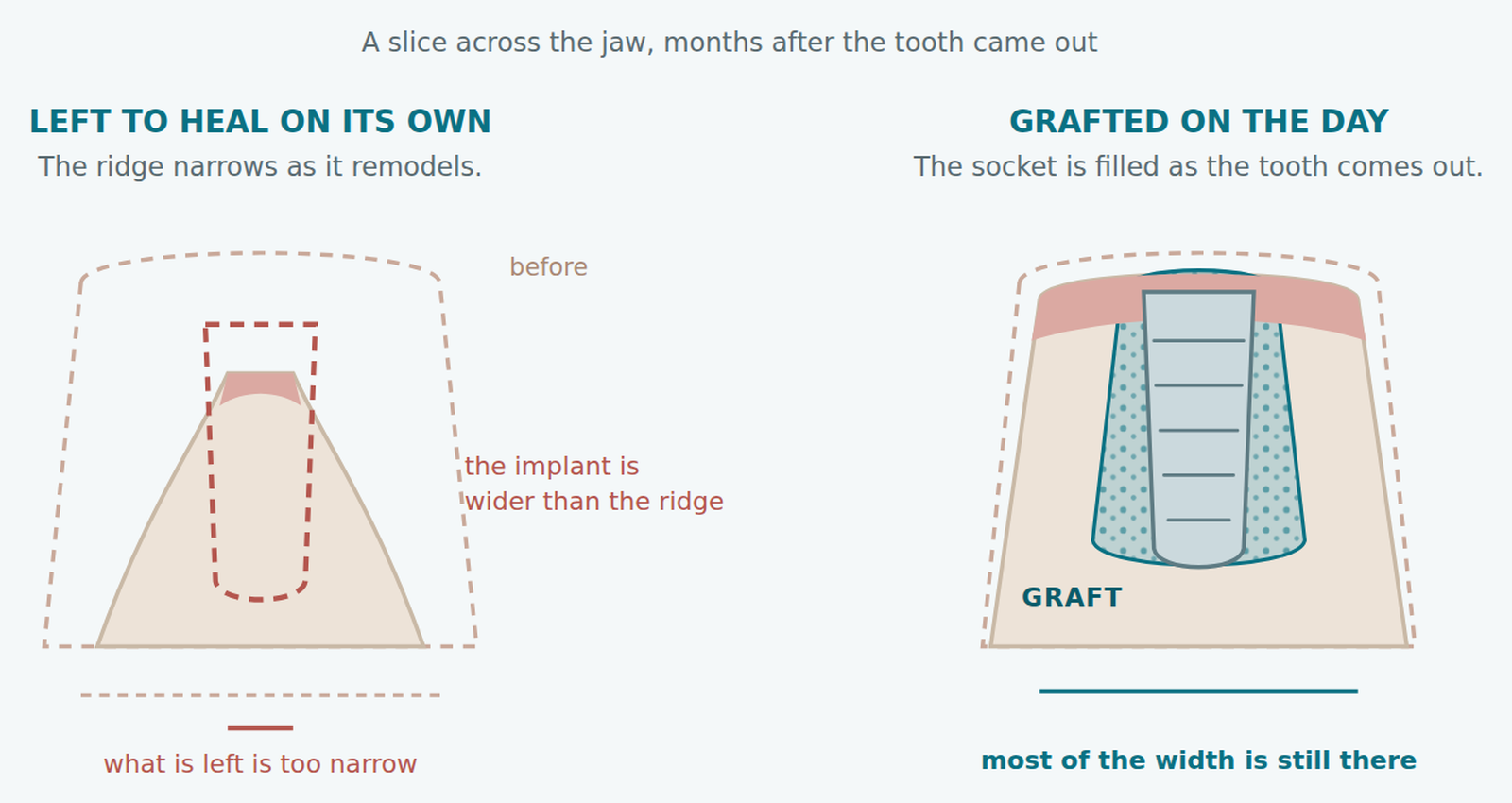
Both of these are the same tooth, months later. On the left nothing was done on the day the tooth came out; on the right the socket was grafted. The dashed line is the shape the ridge had before.
Extraction, graft and implant in one go
Sometimes all three can be done in the same surgery. That is called immediate implant placement, and when conditions allow it, it removes a stage and shortens the whole treatment.
It is not right for everyone. What decides it is how much bone remains, the shape and condition of the socket, whether there is infection and how much, the state of the gums, the position the final tooth needs, and whether the implant can be made stable enough on the day.
When those are not favourable, the safer sequence is to extract and graft, let it heal, and place the implant later.
Our priority is not to place the implant as quickly as possible. It is to place it under the right conditions. Those two things look the same from the outside and are not the same at all.
When a lot of bone is already gone
Some people arrive having lost a great deal of bone — a tooth missing for many years, long-standing gum disease, an old infection, a difficult extraction somewhere else.
Those cases need a larger regeneration procedure: grafting material, a membrane, and in selected cases biologic adjuncts such as platelet-rich plasma. Which technique and which material depend on the size and the location of the defect, and that is decided from the CBCT rather than in advance.
What a sinus lift is
The roots of the upper back teeth sit close to the maxillary sinus. Once those teeth are gone, the bone left between the mouth and the sinus can be too thin to hold an implant of a sensible size.
A sinus lift, or sinus augmentation, builds bone volume in that space. The sinus membrane is carefully lifted and grafting material placed underneath it. Once it has healed, there is usually enough bone for the implant.
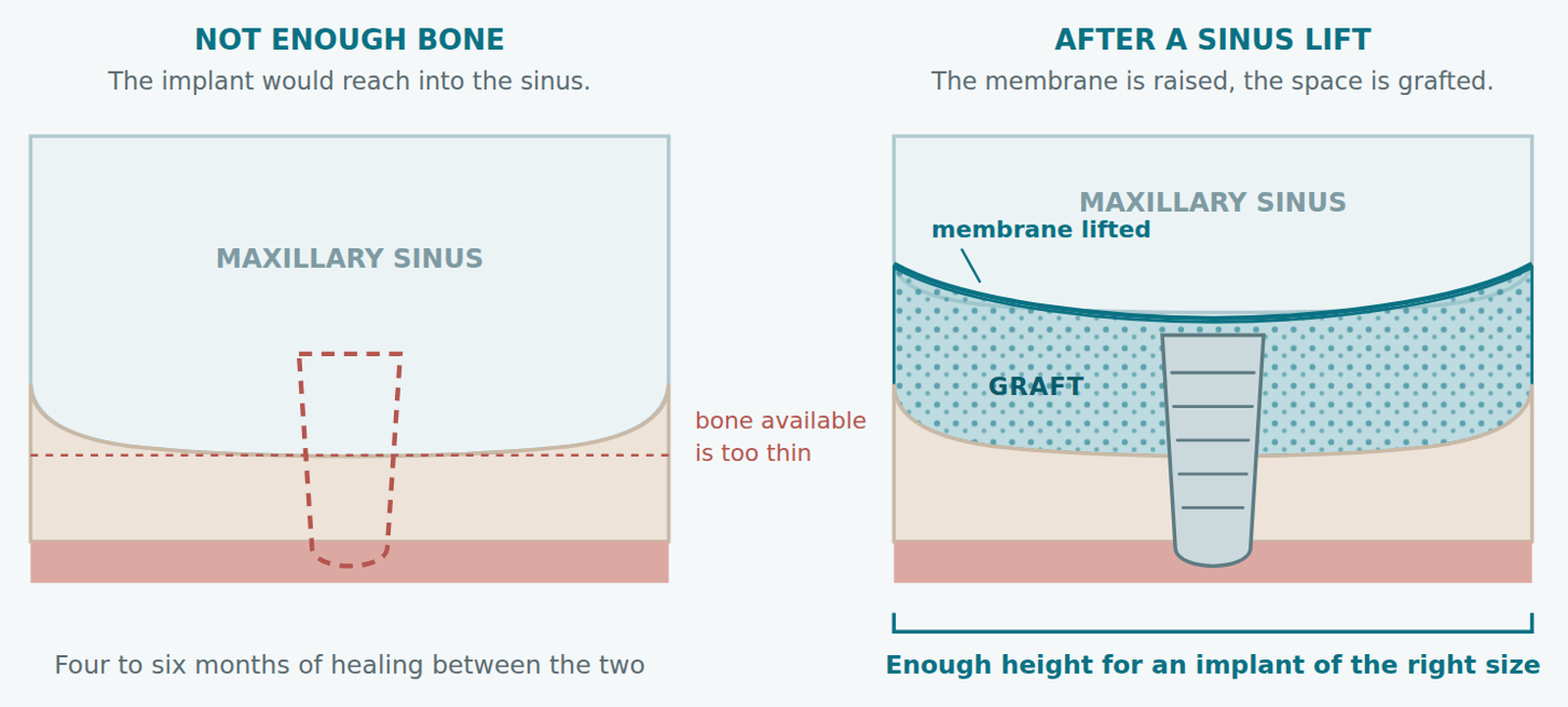
On the left, the implant would have to go further than the bone goes. On the right, the membrane has been raised and the space beneath it filled, and the implant sits inside bone along its whole length.
Not every upper molar needs one
Some people have plenty of bone under the sinus and need no augmentation at all. Others have a moderate amount, and a small lift can be done in the same appointment as the implant. When very little is left, the graft has to be done first and allowed to mature before an implant goes anywhere near it.
Those three outcomes look identical from the outside and cost very different amounts, which is why the scan comes before the quotation.
Together, or in stages
If there is enough existing bone to make the implant stable on the day, the lift and the implant can sometimes be done at once. If there is not, we stage it:
- Sinus lift and bone graft
- Healing, while the graft matures
- Implant placement
- Healing again, while the implant integrates with the bone
- Abutment and ceramic crown
How long it takes to heal
It varies more than people expect. A small graft around an immediate implant is a different thing from rebuilding a large defect or a full sinus augmentation.
As a general guide, a graft usually needs four to six months before the next stage. Larger grafts need longer. After the implant is placed there is a further period while it integrates with the bone.
We do not shorten that to fit a travel schedule. It is the one part of this treatment where hurrying does not save time, it only moves the failure later.
What materials are used
There is no single grafting material that suits every situation. Depending on the case we use bone substitutes and regenerative materials such as Cerabone and Maxgraft, collagen membranes, and in some cases platelet-rich plasma. The choice follows the defect, not a preference.
If you are travelling to Medellín for this
Patients come to us from the United States, Canada, Europe, the Caribbean and across Latin America. When grafting is involved, the scheduling is the part that goes wrong if nobody plans it.
For implant surgery with bone grafting we usually recommend allowing 12 to 14 days in Medellín, depending on the procedure. That covers imaging and examination, the surgical planning, the surgery itself, the early post-operative check, monitoring the healing, and suture removal where it applies.
More extensive grafting, or treatment involving several specialists, needs a different schedule. Coordinate your dates with us before you buy tickets, not after.
How many trips
Two, usually. Three if the grafting has to be staged. The difference between them is months, so it is worth seeing laid out:
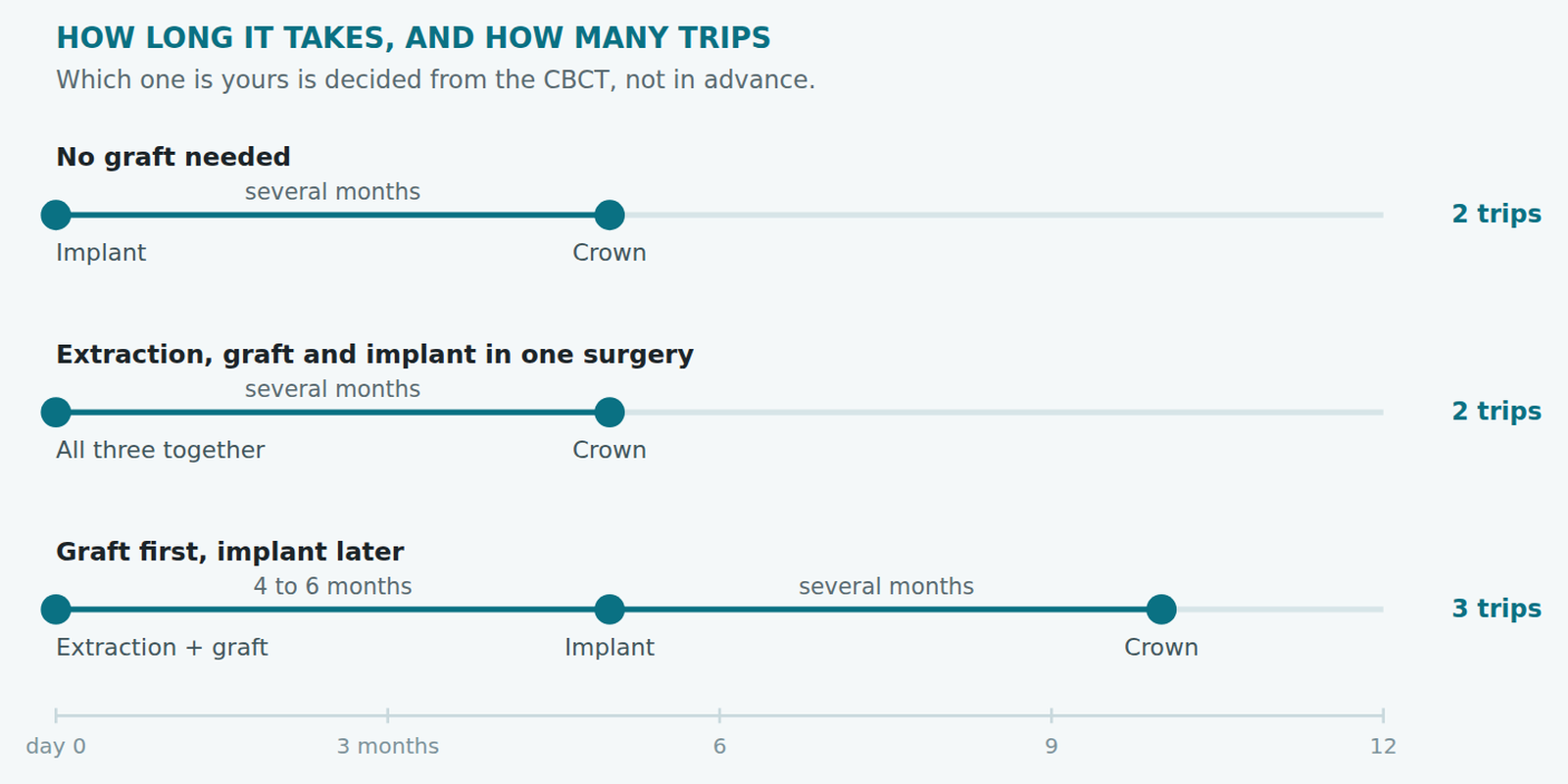
The gaps are healing, not waiting lists. They are the part that cannot be compressed.
There is no responsible way to tell you which of the three you are without looking at your case, and anyone who tells you over email is guessing.
Will there be a gap while it heals
Not a visible one, if the tooth is at the front. Depending on the case that means a temporary removable tooth, another kind of temporary restoration, or in selected immediate cases a temporary supported by the implant itself.
Whatever it is, it has to be made so that it does not press on a healing site or load a new implant. That constraint comes first and the appearance is solved within it.
What bone grafting costs
| COP | |
|---|---|
| Tooth extraction + socket preservation | $2,500,000 – $3,500,000 |
| Sinus lift + bone graft | $3,000,000 – $5,000,000 |
| Implant placement + sinus lift | $4,000,000 – $5,000,000 |
| Extraction + immediate implant + bone graft | $4,500,000 – $5,000,000 |
| CBCT scan | from $550,000 |
These are ranges, not quotations, and the range is wide for a reason. How much bone is there, whether there is infection, the state of the gums, how close the sinus sits, the size of the defect and which grafting technique it needs all move the figure.
A proper number comes after the examination and the CBCT. What the implant itself costs is on its own page, and the two are added together rather than one including the other.
Prices are in Colombian pesos. We quote in pesos because the exchange rate moves — you can check today’s rate.
Who plans it

Dr. Juan Carlos Mejía
Prosthodontist · Oral rehabilitation · 27 years in practice
Implant and regeneration cases are planned together with the periodontist and the laboratory, which matters most exactly when the case is difficult: significant bone loss, the sinus, front teeth, several implants at once. The position of the implant is decided by the tooth that will go on it, and that is a restorative decision as much as a surgical one.
Questions people ask
Is a bone graft always needed before an implant?
No. Plenty of people have enough natural bone and need nothing. It is decided from the examination and the imaging, usually a CBCT, not from the fact that a tooth is missing.
Can the graft and the implant be done at the same time?
In selected cases, yes. It depends on the bone available, on infection, on the anatomy, and on whether the implant can be made stable enough on the day.
Can an implant go in immediately after an extraction?
Often, but not always. The decision should come from the condition of the site, not from a preference for finishing faster.
What is socket preservation?
Grafting done at the moment a tooth is removed, to hold the bone volume of the socket for an implant later.
What is the difference between a bone graft and a sinus lift?
Bone graft is the general term for building bone back. A sinus lift is one specific kind of it, done at the back of the upper jaw where the maxillary sinus limits how much bone is available.
How long after a graft before the implant?
Commonly four to six months, though it varies with the type and size of the graft.
Can I fly after bone graft or implant surgery?
Most international patients can, after an appropriate recovery period. We would rather you stayed long enough for the early follow-up and, where it applies, suture removal. How long depends on what was done.
Do I need a CBCT before a graft or a sinus lift?
For most of these cases, yes. A panoramic is flat; it cannot show bone width or the real relationship to the sinus and the nerves. Planning grafting without three dimensions is planning on an assumption.
Before you book anything
Send us the X-rays and the dental information you already have. We will give you a preliminary read of your situation and general guidance before you travel, and we will tell you plainly that it is preliminary.
The actual plan comes after the examination and the 3D imaging. What we are trying to find is the safest and most predictable sequence for your case — which might be an immediate implant, or socket preservation, or regeneration, or a sinus lift, or an implant with no grafting at all.
Book it.
Write to us on WhatsApp and we will find you a time — this week if you live here, or around your dates if you are flying in. Someone at the clinic who speaks English answers, not a call centre.
Chat on WhatsAppIf you would rather not
- Email info@medellindentalsolutions.com
- Contact form Send us the details Opening hours, how to find us, and a form that reaches the same inbox.