
Sedation dentistry in Medellín, administered by an independent medical team: an anesthesiologist and a nurse, for the whole appointment. From $900,000 COP.
Sedation dentistry is not really a technique question. It is about the reason people ask for it, so that is where this page starts.
Being afraid of the dentist is a reason, not an excuse
A lot of people have not sat in a dental chair for five, ten, fifteen years. Not because they do not care about their teeth, and not because they do not know what is happening to them. They know exactly what is happening, and that is part of the problem.
Usually it traces back to something specific: an appointment as a child that went badly, an injection that did not work and nobody believed them, a dentist who told them to stop being dramatic. Then years pass, the problem grows, and the embarrassment about how much work is now needed becomes its own reason not to come.
You will not be told you should have come sooner. Everybody already knows that, and saying it out loud has never fixed a tooth.
Who gives it
This is the part worth reading carefully, because it is where clinics differ most and it is almost never explained.
Sedation here is administered by an independent medical team — an anesthesiologist and a nurse — who do nothing else during your appointment. Not by the dentist who is also working on your teeth.
That separation is the whole point. A dentist operating and sedating at the same time is dividing attention between two jobs, and one of them is your breathing. Here, two people’s entire job during the appointment is you — not the tooth.
The anesthesiologists are affiliated with SADEA and with the Sociedad Colombiana de Anestesiología y Reanimación, the national anaesthesia society. You have no way of evaluating a Colombian anesthesiologist from abroad, so that is the thing to check rather than take our word for.
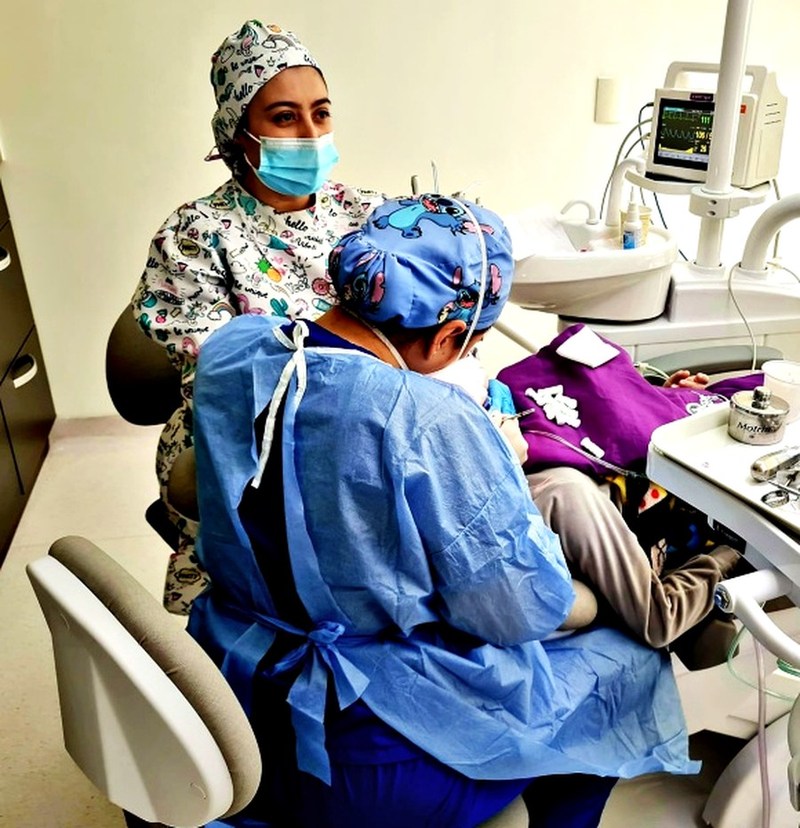
Two people and a monitor. The screen at the back is not decoration — somebody is watching it for the whole appointment.
You are monitored throughout, and you stay monitored after the treatment finishes until the team is satisfied you are ready to leave. That last part takes longer than people expect and it is not negotiable.
What kind of sedation you will have
Start with what it is not. This is not general anaesthesia and you are not put under. You breathe on your own and you stay able to respond when you are spoken to. Sedation runs along a range, and what is used here sits at the lighter end of it — closer to a long, detached calm than to being unconscious.
Exactly how light, and with what, is the anesthesiologist’s decision, made at the pre-anaesthetic assessment, once they have your medical history and know what dental work is planned. A ninety-minute extraction and a three-hour rehabilitation are not the same appointment, and a patient on blood-pressure medication is not the same patient as one on none.
They will tell you which one and why, and you will know before the day rather than as you sit down. If you want to ask sooner than that, ask us and we will put the question to them.
When we suggest it, and when we do not
Most dental treatment does not need sedation dentistry at all, and we do not offer it by default. Local anaesthetic works, and for the great majority of appointments it is the right and lighter answer.
It becomes worth considering when one of these is true:
- The fear is the obstacle, and has been for years. This is the most common reason and the best one.
- The appointment is long — four wisdom teeth, several implants, a full rehabilitation. Three hours in a chair is hard even for people who are not frightened.
- Surgery with grafting, where staying still matters and the work is delicate. Bone grafting and sinus lifts often fall here.
- A child for whom an ordinary appointment is not going to work, after the gentler route has genuinely been tried.
And when it is not warranted we will say so. Sedation adds cost, adds a medical team and adds a recovery period; recommending it for a filling would be selling you something you do not need.
Children
With children, sedation is never the first move. Most of the time the answer is a short first appointment that achieves nothing clinically and everything else, then a second one.
Parents usually want to know what age a child has to be. It is not a number. It depends on the child, on how much work is needed, on how a first visit goes, and on what the anesthesiologist finds in the medical history. A calm child needing one filling and a frightened one needing four are not the same decision.
So the honest answer is that the pediatric dentist and the anesthesiologist make that call together, after seeing your child — and if they think sedation is the wrong route, they will say so before you have committed to anything.
When it is the right route — a long treatment, a child for whom the chair is unbearable — the same medical team does it, with the same monitoring. How we treat children, and why appointments are on Saturdays.
On the day
You will be given instructions beforehand about eating and drinking, and about any medication you take regularly. Follow them exactly. An appointment gets cancelled on the day when they are not followed, and it is cancelled for a reason rather than out of strictness.
You will need somebody to take you home. You cannot drive, and if you are travelling alone, tell us before the appointment so we can plan it with you rather than discover it afterwards.
The rest of that day is written off. Plan nothing.
Before any of this is decided
There is a formal pre-anaesthetic assessment before the day, and it is part of what you are paying for. Sedation dentistry is a medical procedure, so the medical history matters as much as the dental one: conditions you have, medication you take, allergies, previous reactions to anaesthetic, previous surgery.
You will be asked all of it, and the anesthesiologist decides whether sedation is appropriate for you. That decision is theirs, not the dentist’s and not ours, and occasionally the answer is no.
What sedation dentistry costs
| COP | |
|---|---|
| Sedation, appointment of up to one hour | from $900,000 |
That covers the anesthesiologist, the nurse and the pre-anaesthetic assessment, and it is charged on top of the dental treatment rather than instead of it.
Longer appointments are quoted once we know the treatment plan, because the fee follows the time in the chair and the time in the chair follows the work. We will give you that figure before you commit to anything, not on the day.
The treatment prices are on their own pages and the two are added together, so you will be given one total rather than two halves of one.
Prices are in Colombian pesos. We quote in pesos because the exchange rate moves — you can check today’s rate.
If this is the page that brought you here
Write to us on WhatsApp and say so. You do not have to explain it well, and you do not have to describe the teeth.
Plenty of people start that conversation with a sentence like I have not been to a dentist in years and I am dreading this. It is a normal first message here, and the answer will not be a lecture. More about the clinic and the people in it.
Book it.
Write to us on WhatsApp and we will find you a time — this week if you live here, or around your dates if you are flying in. Someone at the clinic who speaks English answers, not a call centre.
Chat on WhatsAppIf you would rather not
- Email info@medellindentalsolutions.com
- Contact form Send us the details Opening hours, how to find us, and a form that reaches the same inbox.